Enhancing maize performance through precision phenotyping
phenomaize@mrizp.rs
Address: Slobodana Bajića 1,11185 Belgrade
Follow On :
PHENO_MaizE
From Field to Data: Completing the 2025 PHENO_MaizE Trials
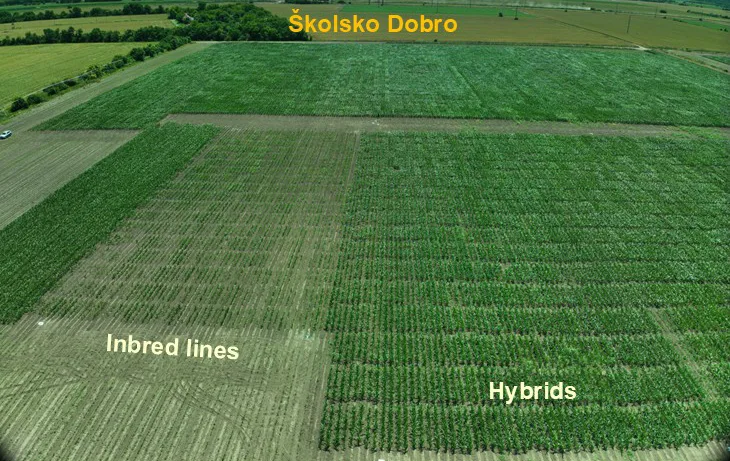
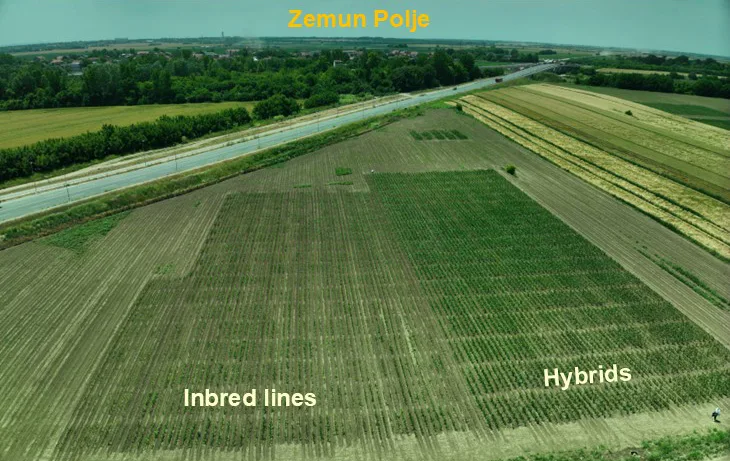
With the 2025 growing season officially behind us, the 2025 PHENO_MaizE trials at both locations — Zemun Polje (ZP) and Školsko Dobro (ŠD) — have been successfully harvested. This marks a major milestone for the project, with large volumes of imaging and ground-truth data now collected. In this article, we summarize the key field activities and share some of the challenges we faced during this first experimental year.
Field Trials Overview
Experiments were sown in late April at ŠD and in early May at ZP. To suppress weeds, herbicide spraying was carried out at both sites after emergence and again during the early vegetative stage.
As is often the case in field research, the season brought its share of challenges. After a very humid May, June turned exceptionally dry — nearly 30 consecutive days without measurable rainfall — putting the genotypes’ drought resilience to the test. At ZP, one irrigation was necessary, as the site had been sown later and young plants entered the dry period at a vulnerable stage.
At the ŠD site, strong weed pressure and sporadic lodging caused by a summer storm complicated field operations and will require additional data cleaning and validation. In some plots, lodged and intertwined plants made it impossible to collect certain traits.
Picture 1. and Picture 2. Field experiments at both locations in mid-June.
UAS-Based Image Data Collection
Both sites were imaged 22 times throughout the season — once a week during the vegetative phase and twice a week during the flowering period. Trials with inbred lines were imaged at 15 m altitude throughout the season, while hybrid trials were flown at 20 m from mid-vegetative stage onward.
Despite careful planning, several factors affected the imaging schedule. Persistent rain in May limited access to the fields, while later in the season strong winds, high temperatures, and occasional flight bans lasting several days to weeks further constrained operations.
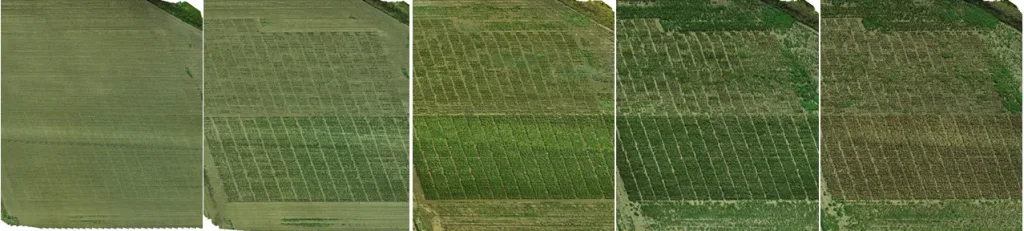
Notably, all orthomosaics have been successfully assembled, ensuring that the imaging dataset is ready for further processing and analysis.
Picture 3. Orthomosaic excerpts from the Zemun Polje site at five time points during the 2025 season, illustrating crop development across different growth stages.
Ground Truth Measurements - 2025 PHENO_MaizE trials
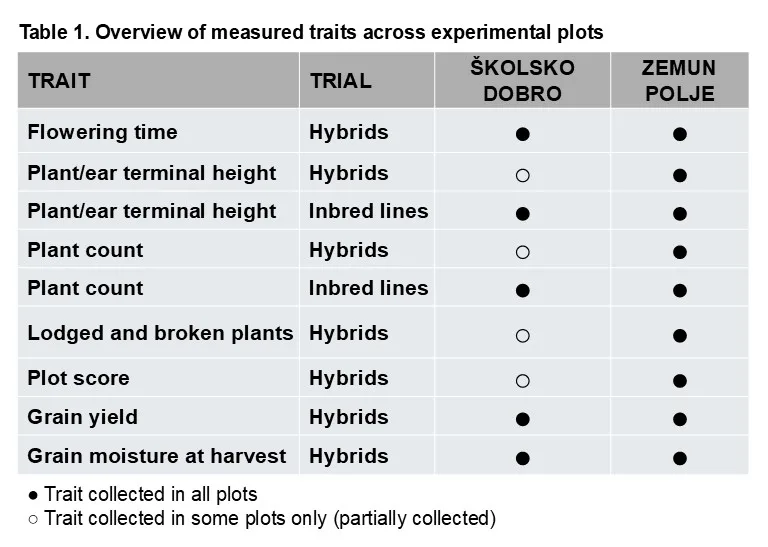
Throughout the season, the team systematically recorded a set of agronomic traits essential for linking UAV-based indices with field performance. However, strong winds in June caused lodging in several ŠD hybrid plots, resulting in missing data for some traits such as plant height and plant count. Extracting accurate information from these affected plots will require additional processing, but such challenges are expected in large-scale field phenotyping.
Connecting Field and UAV Data - 2025 PHENO_MaizE trials
With harvest data now available, the focus is shifting toward integrating field-measured traits with UAV-derived variables — including vegetation indices, canopy structure, and growth dynamics. This integration will allow the PHENO_MaizE team to better quantify genotype × environment interactions and build predictive models to support future breeding work.
Share the inspiration - spread the positivity to the world!